



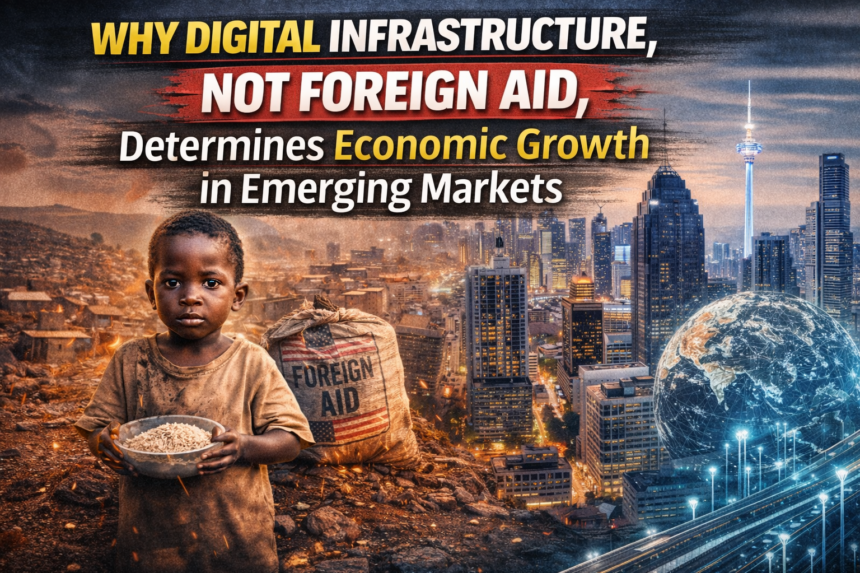
A systematic analysis for policymakers, investors, and development professionals rethinking growth strategies in the Global South
- The Development Paradigm That Stopped Working
- Digital Infrastructure: Definition and Economic Function
- What Most Development Literature Gets Wrong
- Why Digital Infrastructure Has Become the Primary Growth Determinant
- The Service Economy Transformation
- The Platform Economy Access Gate
- The Foreign Direct Investment Calculation
- The Remittance and Capital Flow Transformation
- Practical Implications Across Development Contexts
- For Resource Rich Economies
- For Geographically Disadvantaged Countries
- For Large Population Low Income Countries
- Limitations and When Traditional Development Priorities Still Matter
- The Future of Development Economics and Policy
- Key Takeaways
- Why This Recognition Defines Development Success Over the Coming Decade
The Development Paradigm That Stopped Working
For seven decades, the international development community has operated under the assumption that foreign aid, preferably directed toward health, education, and governance institutions, creates the foundation for economic growth in emerging markets. Yet countries receiving the most aid per capita have shown some of the slowest growth trajectories, while nations that prioritized digital infrastructure development have achieved GDP growth rates that outpace developed economies by multiples.
Most development discourse treats digital infrastructure as a luxury: something countries should invest in after achieving basic development milestones like food security, healthcare access, and literacy. What is rarely addressed is that digital infrastructure has become the primary determinant of whether emerging economies can participate in global value chains, attract foreign investment, and enable their populations to generate income in the modern economy.
This matters because trillions in development aid and philanthropic capital are being allocated based on frameworks designed for an analog economy that no longer exists. Countries optimizing for traditional development metrics while neglecting digital infrastructure are creating populations with education and healthcare access but without economic opportunities. Understanding this shift is essential for anyone involved in development policy, emerging market investment, or international economic planning.
Digital Infrastructure: Definition and Economic Function
Digital infrastructure encompasses the physical and virtual systems that enable internet connectivity, digital transactions, and electronic service delivery. This includes telecommunications networks, data centers, payment systems, digital identity platforms, and the regulatory frameworks that govern their operation.
The economic function of digital infrastructure differs fundamentally from physical infrastructure like roads or ports. Traditional infrastructure reduces transaction costs within geographical boundaries. A highway connecting two cities makes physical commerce cheaper between those locations. Digital infrastructure eliminates geographical constraints entirely, allowing a software developer in Lagos to serve clients in London, or a craftsperson in Bangalore to sell directly to consumers in Boston.
This distinction is critical because it changes the calculus of development investment returns. Building a road generates returns proportional to the volume of trade between the connected regions. Building digital infrastructure generates returns proportional to the global economy’s size, because it connects local producers to global markets without intermediary steps.
Digital infrastructure also exhibits extreme network effects that physical infrastructure lacks. The first mile of highway provides minimal value until more miles connect it to destinations. The first megabit of internet bandwidth in a village immediately connects that village to the entire world’s digital economy. Early digital infrastructure investments generate disproportionate returns compared to incremental improvements in physical systems.
The fundamental transformation is that digital infrastructure converts geographic disadvantage into irrelevance. A landlocked country with poor port access faces permanent constraints in physical trade. That same country with robust digital infrastructure can export services, intellectual property, and digital goods without touching a shipping container. This represents the first technology in human history that can genuinely overcome geographical determinism in economic development.
What Most Development Literature Gets Wrong
The mainstream development community has been remarkably slow to recognize digital infrastructure’s primacy, continuing to allocate resources based on frameworks that predate the internet economy. This represents not just missed opportunity but active harm to the populations these frameworks claim to serve.
Misconception one: that traditional development milestones must precede digital infrastructure investment. The dominant framework suggests countries should achieve literacy, healthcare, and governance improvements before investing in advanced digital systems. This sequencing is exactly backward. Digital infrastructure enables more efficient delivery of education (remote learning), healthcare (telemedicine), and governance (digital services) than traditional brick and mortar approaches.
Rwanda demonstrates this inversion clearly. Rather than waiting until it achieved developed world education levels, the country invested heavily in fiber optic networks and 4G coverage. This enabled digital education platforms that reached rural populations at a fraction of the cost of building physical schools. Educational outcomes improved faster than countries spending comparable amounts on traditional school construction.
Misconception two: that foreign aid builds institutional capacity that enables growth. Decades of aid focused on institution building have produced limited results because institutions optimized for analog systems cannot create opportunities in a digital economy. Training government bureaucrats in paper based processes doesn’t help citizens access global remote work opportunities. Building institutions around digital infrastructure creates capacity that compounds rather than depreciates.
The implication is that aid optimizing for governance metrics and institutional quality often creates systems that are internally coherent but externally irrelevant. A country might achieve high scores on World Bank governance indicators while its citizens cannot access digital payment systems, making them unable to participate in the gig economy, receive remittances efficiently, or build credit histories that enable entrepreneurship.
Misconception three: that digital infrastructure primarily benefits educated elites. The common critique suggests investing in technology before achieving universal literacy benefits only the small percentage of the population already advantaged. Evidence suggests the opposite. Digital infrastructure provides the greatest relative benefit to populations excluded from traditional opportunity structures.
A farmer with limited formal education but a smartphone can access commodity prices, weather forecasts, and connect directly with buyers, bypassing exploitative intermediaries. A craftsperson can sell globally through digital marketplaces without needing English literacy or understanding international shipping logistics. Digital platforms reduce barriers to economic participation more effectively than traditional development programs that require years of institutional interaction to generate benefits.
Misconception four: that infrastructure development follows predictable stages requiring patience. Development theory suggests countries must slowly build capacity through sequential improvements. Digital infrastructure allows stage skipping on an unprecedented scale. Countries never building extensive landline telephone networks can leap directly to mobile broadband. Nations with underdeveloped banking systems can implement mobile money platforms superior to traditional financial infrastructure.
This stage skipping creates path dependencies that determine decades of future development trajectories. Countries that prioritize digital infrastructure in their development sequence create populations positioned to capture value in the global digital economy. Those that follow traditional sequences create populations with 20th century skills competing in 21st century labor markets.
Misconception five: that digital infrastructure is too expensive for developing countries to prioritize. Cost comparison analysis typically presents digital infrastructure as requiring capital that could be spent on immediate human needs. This ignores both the declining cost of digital systems and the opportunity cost of populations disconnected from the digital economy.
Installing nationwide fiber and 4G coverage costs less than building comprehensive road networks to achieve equivalent connectivity. More importantly, digital infrastructure generates revenue that can fund other development priorities. Mobile money platforms generate transaction fees that can be taxed. Digital services create formal sector jobs that generate income tax revenue. Traditional aid generates consumption but not sustainable revenue streams.
Why Digital Infrastructure Has Become the Primary Growth Determinant
The global economy has fundamentally restructured around digital platforms, services, and transactions in ways that make digital connectivity the gateway to economic participation. Understanding this mechanism reveals why traditional development approaches are increasingly ineffective.
The Service Economy Transformation
Global economic growth is increasingly concentrated in services rather than manufacturing or agriculture. Services represented 65% of global GDP in 2023, with the fastest growing segments being information technology, business services, and digital content creation. Critically, services trade faces dramatically lower barriers to entry than physical goods trade.
Manufacturing exports require establishing supply chains, navigating customs regulations, meeting product standards, and accessing shipping infrastructure. Service exports require internet connectivity and relevant skills. A programmer in Vietnam can contribute to a codebase in California with latency measured in milliseconds. A designer in Kenya can create graphics for a marketing agency in Copenhagen with no physical infrastructure beyond a laptop and broadband connection.
The consequence is that countries with robust digital infrastructure can capture service economy opportunities immediately, while those without digital access are excluded entirely regardless of their human capital quality. India’s IT services boom occurred not because Indian engineers were uniquely talented but because telecommunications liberalization in the 1990s created connectivity enabling those engineers to serve global clients.
This reveals the false choice between human capital development and infrastructure investment. Education spending without digital connectivity creates educated populations with limited economic opportunities. Digital infrastructure without education wastes potential. But when forced to sequence, digital infrastructure enables ongoing self directed learning and skill development through online platforms, while education without connectivity provides static knowledge disconnected from evolving market demands.
The Platform Economy Access Gate
The global economy increasingly operates through digital platforms that match supply with demand across borders. Upwork connects freelancers with clients. Shopify enables e-commerce. YouTube monetizes content creation. These platforms represent the fastest growing segment of the global economy and require only internet access to participate.
Countries with poor digital infrastructure exclude their populations from platform economies entirely. A talented graphic designer in a country with unreliable internet cannot reliably deliver work to international clients. An entrepreneur with a marketable product cannot establish an online store if payment processing infrastructure doesn’t exist. The opportunity cost compounds: not only do these individuals lose income, but the country loses the tax revenue, foreign exchange earnings, and multiplier effects their participation would generate.
The platform economy also creates asymmetric advantages for early participants. Platform algorithms reward consistency and track record. Freelancers from countries that established digital infrastructure in the 2000s built reputation capital that compounds over time. New market entrants compete at a disadvantage even if their skill levels match. Countries that delay digital infrastructure investment don’t just postpone benefits; they create permanent disadvantages for their populations in platform reputation systems.
The Foreign Direct Investment Calculation
Foreign investors evaluating emerging markets increasingly prioritize digital infrastructure over traditional factors like natural resources or labor costs. A manufacturing facility can locate in low wage countries, but only if it can maintain just in time inventory systems, coordinate with global supply chains, and implement modern enterprise software. All of this requires robust digital connectivity.
The constraint is that digital infrastructure cannot be easily substituted. A company can work around poor road infrastructure by building private roads or using air transport. It cannot work around absent digital infrastructure because modern business operations fundamentally depend on real time data connectivity. The minimum viable digital infrastructure threshold for attracting high value FDI has risen dramatically.
This creates a bifurcation in emerging markets. Countries that prioritized digital infrastructure attract investment in high productivity sectors: technology, business services, advanced manufacturing. Those that delayed digital investment only attract investment in sectors requiring minimal connectivity: resource extraction, low tech agriculture, and labor intensive manufacturing with declining margins. The former creates middle class jobs and generates sustained growth. The latter creates low wage employment with limited advancement opportunities.
The Remittance and Capital Flow Transformation
Remittances represent the largest capital flow to many developing countries, exceeding foreign aid and foreign direct investment combined. Digital financial infrastructure determines whether these flows create development impact or dissipate through inefficiency.
Traditional remittance systems extract enormous fees. Sending money through conventional channels costs 6% to 12% in fees, with funds taking days to arrive and requiring recipients to travel to collection points. Mobile money systems and digital payment platforms reduce costs to under 2% with instant delivery to recipients’ phones. For countries receiving tens of billions in remittances annually, this efficiency difference represents billions in additional capital retained.
Beyond efficiency, digital financial systems enable remittances to catalyze development rather than just fund consumption. When remittances arrive via digital wallets, recipients can immediately access credit, savings products, and insurance through the same platform. This converts remittances into capital that enables entrepreneurship rather than consumption smoothing. Countries with robust digital financial infrastructure see remittances funding small business formation at rates multiples higher than countries where remittances arrive as cash.
Practical Implications Across Development Contexts
The primacy of digital infrastructure manifests differently based on country context, but the pattern remains consistent: digital connectivity determines economic trajectory more than traditional development indicators.
For Resource Rich Economies
Countries with significant natural resource wealth face the “resource curse” where extractive industries dominate, create limited employment, and crowd out diversified economic development. Digital infrastructure provides the clearest path to economic diversification because it enables service sectors that develop independently of natural resources.
The United Arab Emirates demonstrates this transition. Recognizing that oil dependence was unsustainable, the country invested massively in telecommunications infrastructure, established free zones for digital businesses, and positioned itself as a regional technology hub. Dubai now generates more GDP from services and technology than from oil, creating a diversified economy resilient to commodity price fluctuations.
For resource rich developing countries, the decision making impact is existential. Natural resource revenues provide temporary fiscal capacity to build digital infrastructure before commodity prices decline. Countries that invest resource wealth in digital systems create sustainable economic diversification. Those that spend resource revenues on consumption or physical monuments squander their only opportunity to escape resource dependence.
For Geographically Disadvantaged Countries
Landlocked or remote countries face permanent disadvantages in physical trade due to transportation costs and distance from major markets. Digital infrastructure allows these countries to overcome geographical constraints by enabling service exports that face no distance penalty.
Mongolia, landlocked between China and Russia, invested in expanding broadband access and established technology free zones. This enabled its population to provide outsourced services to Asian markets despite having no ocean access. Software development, business process outsourcing, and digital content creation now represent growing portions of the economy, providing alternatives to mining that dominated historically.
The implication for geographically disadvantaged countries is that digital infrastructure investment generates disproportionate returns compared to physical infrastructure. A landlocked country spending capital on roads still faces fundamental trade disadvantages. That same country investing in fiber optics and data centers eliminates geographical constraints for growing portions of its economy.
For Large Population Low Income Countries
Countries with large young populations face demographic pressures where traditional job creation cannot keep pace with workforce growth. Digital infrastructure enables distributed entrepreneurship and freelance work at scales impossible through traditional employment.
Bangladesh, with 170 million people and limited industrial base, prioritized mobile broadband expansion. This enabled millions to participate in the global gig economy, earning income through freelance platforms, remote work, and digital services. While individual incomes remain modest by global standards, they exceed local alternatives and require minimal infrastructure beyond connectivity.
For large population countries, digital infrastructure provides the only scalable solution to unemployment. Building enough factories to employ millions requires decades and massive capital. Providing internet access allows millions to immediately begin generating income through global platforms. The approach isn’t a complete solution but represents the fastest path to widespread income generation.
Limitations and When Traditional Development Priorities Still Matter
Digital infrastructure is not a panacea, and understanding its limitations prevents over correction from traditional development approaches to technology determinism.
Digital infrastructure cannot address every development challenge. Countries facing active conflict, state collapse, or severe humanitarian crises need immediate stabilization and humanitarian aid before digital infrastructure investments generate returns. Similarly, countries with extreme poverty where populations lack basic nutrition cannot leapfrog directly to digital economies while ignoring immediate survival needs.
The effectiveness of digital infrastructure also depends on complementary factors. Connectivity without reliable electricity provides limited benefit. Internet access without basic literacy restricts economic opportunities to narrow segments. Digital financial systems require regulatory frameworks preventing fraud and enabling consumer protection. These complementary investments matter and cannot be ignored entirely.
The limitation is also temporal. Digital infrastructure generates returns over years, not months. Countries facing immediate fiscal crises cannot rely solely on long term infrastructure investments. Traditional aid and development assistance remain relevant for crisis response and immediate need addressing, even if they’re less effective at generating sustained growth.
However, these limitations don’t undermine the core argument that digital infrastructure has become the primary growth determinant for countries past immediate survival thresholds. The question is not whether to ignore traditional development priorities entirely but whether digital infrastructure deserves primacy in resource allocation and strategic planning for countries seeking sustained economic growth.
Critics correctly note that digital infrastructure can increase inequality if access is concentrated geographically or demographically. Urban areas often receive connectivity before rural regions. Educated populations adopt technology faster than less educated groups. These distributional concerns require addressing through deliberate policy ensuring widespread access rather than concentrated benefits.
The Future of Development Economics and Policy
The recognition that digital infrastructure drives growth more than traditional aid or physical infrastructure will transform development economics over the coming decade, creating fundamental shifts in how resources are allocated and success is measured.
Development institutions are beginning this transition, but too slowly. The World Bank has increased digital development lending, but it still represents a small fraction of overall portfolios. Bilateral aid still flows predominantly to traditional health, education, and governance programs. This lag between evidence and resource allocation costs developing countries billions in foregone growth annually.
Multilateral development banks are exploring new financing vehicles specifically for digital infrastructure. The infrastructure asset class is evolving to recognize that fiber optic networks and data centers generate returns comparable to traditional infrastructure like toll roads. This financial innovation could unlock private capital for digital infrastructure at scales impossible through aid budgets alone.
Technology companies are also emerging as development actors, investing in connectivity infrastructure that governments cannot fund alone. Google, Facebook, and telecommunications companies are deploying submarine cables, satellite internet, and terrestrial networks in emerging markets. While these private investments serve corporate interests, they generate positive externalities by expanding connectivity.
Regulatory innovation is accelerating as countries recognize that outdated telecommunications regulations prevent infrastructure deployment. Spectrum allocation, infrastructure sharing, and right of way policies designed for monopoly landline providers are being reformed to enable competitive mobile broadband deployment. These regulatory changes often generate more impact than financial aid by reducing deployment costs and accelerating buildout.
The broader trajectory suggests a development paradigm shift where digital infrastructure becomes the core metric of development progress rather than a secondary consideration. Countries will be evaluated not just on poverty rates or literacy but on broadband penetration, digital payment adoption, and populations’ ability to access global digital platforms. This measurement shift will drive resource allocation changes as policymakers optimize for metrics that actually correlate with economic growth.
Key Takeaways
Digital infrastructure eliminates geographical disadvantage in ways physical infrastructure cannot. Prioritize connectivity investments that link populations to global markets over incremental improvements in local physical infrastructure that maintains isolation.
Service economy participation requires only connectivity, not decades of institution building. Countries can generate foreign exchange and employment through digital services immediately rather than waiting for traditional development milestones.
Stage skipping is possible and advantageous. Countries can implement mobile money without building banking infrastructure, provide digital education without constructing schools in every village, and enable e commerce without developing retail infrastructure. This stage skipping accelerates development timelines by decades.
Platform economy access is binary. Either populations can reliably access global digital platforms or they cannot. Marginal improvements in connectivity quality matter less than achieving minimum viable bandwidth thresholds that enable participation.
Foreign investment follows digital infrastructure, not cheap labor. High productivity foreign direct investment requires modern digital systems. Countries compete for investment based on connectivity quality as much as labor costs or regulatory environment.
Remittance efficiency creates billions in development capital. Digital payment systems convert remittance fees from value leakage into retained capital that can fund entrepreneurship and growth.
Why This Recognition Defines Development Success Over the Coming Decade
The countries that recognize digital infrastructure’s primacy and allocate resources accordingly will achieve growth trajectories that make traditional development approaches look archaic. Those that continue optimizing for outdated frameworks will watch their populations fall further behind global living standards regardless of how many clinics or schools they build.
The long term implication is that development economics itself must fundamentally restructure its theories, metrics, and recommendations. The field was built around assumptions of sequential industrialization that no longer reflect how modern economies generate wealth. Digital platforms, service exports, and knowledge work represent the new pathways to prosperity, and these pathways require digital infrastructure as the foundational prerequisite.
For policymakers in emerging markets, this represents both challenge and opportunity. The challenge is that building digital infrastructure requires technical expertise, regulatory reform, and capital investment that traditional development aid doesn’t provide. The opportunity is that countries making these investments can achieve growth rates previously impossible for emerging economies, closing income gaps with developed nations in decades rather than centuries.
The international development community faces a choice: evolve its frameworks to reflect the digital economy’s realities or become increasingly irrelevant as countries recognize that aid optimized for analog economies provides minimal value. The development approaches that worked in rebuilding post war Europe or industrializing East Asia in the 20th century cannot create prosperity in 21st century conditions where economic value is digital, mobile, and globally distributed.
Countries that prioritize digital infrastructure, implement regulatory frameworks enabling platform economy participation, and ensure broad based connectivity access will create prosperity for their populations at unprecedented speed. Those that treat digital systems as luxuries to pursue after achieving traditional milestones will create educated, healthy populations locked out of the global economy, wondering why development investments failed to generate growth. The difference between these trajectories is becoming clearer with each passing year, and the gap between digital and non digital economies will only widen as network effects compound.