

Introduction
Artificial intelligence has become one of the most discussed forces shaping modern work. Headlines often suggest that entire professions are on the brink of disappearance, while others promise unprecedented productivity and opportunity. For many people, this creates confusion and anxiety.
- Introduction
- How AI Changes Jobs Rather Than Eliminates Them
- 3. Jobs That Are Changing the Most
- 3.1 Administrative and Clerical Roles
- Customer Support and Service Roles
- Marketing and Content Related Roles
- Software Development and IT Work
- Jobs That Are Changing More Slowly
- Jobs That Remain Largely Unchanged
- Leadership and Management Roles
- Care and Service Roles Centered on Human Interaction
- Creative and Artistic Professions
- Why Some Jobs Change Faster Than Others
- Skills That Matter More in an AI Shaped Workplace
- The Gap Between Public Fear and Economic Reality
- What This Means for Workers and Employers
- Looking Ahead Without Hype or Fear
- Conclusion
Is AI truly replacing jobs, or is it simply changing how work is done? The answer lies somewhere in between, and it is far more nuanced than the extremes usually presented.
Historically, every major technological shift has reshaped labor rather than eliminating it outright. The industrial revolution replaced some forms of manual labor but created factories, logistics networks, and entirely new professions.
The computer age automated clerical tasks yet gave rise to software development, digital marketing, and global information work. Artificial intelligence follows a similar pattern, but at a faster pace and with deeper reach into cognitive tasks once considered uniquely human.
This article takes a grounded and evidence based look at which jobs are actually changing because of AI and which largely remain the same. Instead of focusing on speculative futures, it examines real world adoption, practical limitations, and economic incentives driving AI use today.
The goal is not to predict mass unemployment or utopian efficiency, but to clarify where change is happening, where it is overstated, and why human work continues to matter.
How AI Changes Jobs Rather Than Eliminates Them
One of the biggest misconceptions about AI is that it replaces entire jobs. In reality, most occupations consist of many tasks, not all of which are equally automatable. AI excels at pattern recognition, data processing, and repetitive cognitive work.
It struggles with context, accountability, physical interaction in unpredictable environments, and social nuance.
As a result, AI tends to change jobs by altering task composition. Certain tasks are automated, others are augmented, and new responsibilities emerge. A role may look different day to day, but it rarely disappears overnight.
This distinction is critical because it explains why employment data often fails to match the alarmist tone of public discourse.
Companies adopt AI primarily to reduce friction, increase speed, or improve consistency, not to remove humans entirely. Human oversight remains necessary for decision making, ethical judgment, quality control, and customer trust.
Jobs change when AI removes low value tasks and shifts human effort toward higher value work.
3. Jobs That Are Changing the Most
Some roles are experiencing significant transformation because their core tasks align closely with what AI does well. These jobs are not vanishing, but their skill requirements and workflows are evolving rapidly.
3.1 Administrative and Clerical Roles
Administrative work has long been shaped by automation, and AI accelerates this trend. Tasks such as scheduling, data entry, document summarization, and basic correspondence can now be handled by AI systems with minimal supervision.
This does not eliminate administrative roles entirely. Instead, it reduces the time spent on routine work and increases the importance of coordination, problem solving, and interpersonal communication. Administrative professionals who adapt by managing systems, handling exceptions, and supporting strategic workflows remain valuable.
The number of entry level clerical roles may decline, but experienced administrators who understand organizational context often become more central, not less.
Customer Support and Service Roles
AI powered chat systems and voice assistants are increasingly used for first level customer support. They handle common questions, simple troubleshooting, and routine requests efficiently and at scale.
However, customers still prefer human interaction for complex issues, emotional situations, or high stakes decisions. As a result, customer support roles are shifting toward escalation handling, relationship management, and problem resolution rather than basic information delivery.
This change favors workers with strong communication skills, empathy, and product understanding. It also reduces burnout by offloading repetitive interactions to automated systems.
Marketing and Content Related Roles
Marketing has embraced AI tools for data analysis, audience segmentation, content drafting, and performance optimization. AI can generate variations of text, analyze engagement metrics, and suggest improvements faster than human teams working alone.
Yet creativity, brand voice, and strategic judgment remain human responsibilities. Marketers increasingly act as editors, strategists, and decision makers rather than pure content producers. The role becomes less about volume and more about direction, coherence, and ethical messaging.
Those who understand both marketing fundamentals and AI tools gain an advantage, while purely mechanical content production loses relevance.
Software Development and IT Work
Contrary to popular fear, AI has not eliminated programmers. Instead, it changes how code is written and maintained. AI tools assist with debugging, code completion, documentation, and pattern recognition.
This shifts developer focus toward system design, architecture, security, and integration. Junior developers may face higher entry barriers as basic coding becomes easier to automate, but skilled engineers who understand systems holistically remain in demand.
The job becomes less about writing code line by line and more about understanding what should be built, why it matters, and how it fits into broader systems.
Jobs That Are Changing More Slowly
Not all professions experience rapid transformation. Some roles change gradually because their tasks require human presence, trust, or adaptability that AI struggles to replicate.
Healthcare Professionals
AI plays an expanding role in diagnostics, imaging analysis, and administrative support in healthcare. However, doctors, nurses, and caregivers remain essential due to the human complexity of medical care.
Patients value empathy, explanation, and trust. Clinical decisions often involve ethical considerations, uncertainty, and individualized judgment. AI supports healthcare workers by providing insights and reducing paperwork, but it does not replace the human relationship at the center of care.
The biggest change in healthcare roles is efficiency and information access, not job elimination.
Education and Teaching Roles
AI tools assist with grading, lesson planning, and personalized learning suggestions. They can adapt content to student needs and provide supplemental explanations.
Still, teaching is fundamentally social. Motivation, mentorship, classroom dynamics, and emotional support cannot be automated effectively. Teachers remain central to learning environments, even as their tools evolve.
AI changes how teachers prepare and assess, but not why they are needed.
Skilled Trades and Physical Work
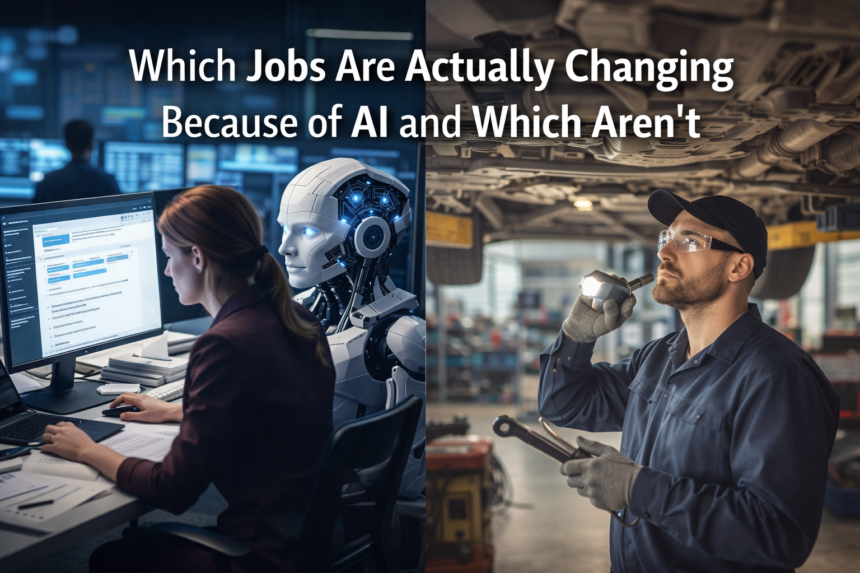
Electricians, plumbers, construction workers, and technicians operate in complex physical environments that vary widely. AI struggles with unpredictable settings, fine motor skills, and on site judgment.
While planning, diagnostics, and logistics may be enhanced by AI, the core physical work remains human driven. Robotics plays a role in controlled environments, but widespread replacement in trades is slow and expensive.
These jobs change through better tools and information, not displacement.
Jobs That Remain Largely Unchanged
Some roles experience minimal impact from AI because their value lies in human presence, accountability, or creativity that cannot be easily codified.
Leadership and Management Roles
AI provides data and insights, but leadership involves vision, persuasion, ethical responsibility, and cultural stewardship. Managers must navigate ambiguity, motivate people, and make decisions with incomplete information.
AI may inform leaders, but it does not replace them. In fact, as technology accelerates change, strong leadership becomes more important, not less.
Care and Service Roles Centered on Human Interaction
Roles such as therapists, social workers, childcare providers, and community organizers rely heavily on trust, emotional intelligence, and social context. These qualities are difficult to replicate with machines.
AI may support these professions with scheduling or documentation, but the core work remains deeply human.
Creative and Artistic Professions
While AI can generate images, music, and text, human creativity remains distinct in intention, cultural meaning, and originality. Artists, writers, and designers increasingly use AI as a tool, not a replacement.
The value of creative work lies in perspective, interpretation, and connection with audiences. AI expands possibilities but does not eliminate the need for human expression.
Why Some Jobs Change Faster Than Others
The pace of change depends on several factors. Cost is a major driver. If AI can perform a task more cheaply and reliably than humans, adoption accelerates. Regulation also matters. Highly regulated fields change more slowly due to safety and accountability concerns.
Cultural acceptance plays a role as well. Customers may tolerate AI in some contexts but resist it in others. A chatbot answering a shipping question is acceptable, while an AI delivering medical diagnoses without human oversight is not.
Finally, organizational readiness determines impact. Companies with digital infrastructure and skilled workers integrate AI more effectively than those without.
Skills That Matter More in an AI Shaped Workplace
As tasks shift, certain skills grow in importance across professions.
Critical thinking becomes essential as AI generates outputs that require evaluation. Communication skills matter more as humans focus on explanation, negotiation, and collaboration. Domain expertise remains valuable because AI lacks true understanding of context.
Adaptability is perhaps the most important skill. Workers who learn new tools and adjust their roles proactively benefit from AI rather than competing with it.
The Gap Between Public Fear and Economic Reality
Public narratives often focus on worst case scenarios, but labor data shows gradual change rather than sudden collapse. Employment shifts occur over years, not months. New roles emerge alongside changing ones.
Fear persists because AI affects cognitive work, which many people associate with job security. However, history shows that technology reshapes work structures more than it removes the need for human labor.
Understanding this gap helps individuals and organizations respond rationally rather than reactively.
What This Means for Workers and Employers
For workers, the key takeaway is that relevance comes from skills, not job titles. Continuous learning and flexibility provide resilience. Employers benefit most when they use AI to augment employees rather than replace them, improving productivity and retention simultaneously.
Organizations that treat AI as a partnership tool tend to see better outcomes than those focused solely on cost cutting.
Looking Ahead Without Hype or Fear
AI will continue to change how work is done, but it will not uniformly replace jobs. Some roles evolve quickly, others slowly, and many remain fundamentally human. The future of work depends less on the technology itself and more on how societies choose to deploy it.
Policies, education systems, and corporate strategies all shape outcomes. When aligned with human strengths, AI becomes a force for enhancement rather than displacement.
Conclusion
The question is not whether jobs are changing because of AI, but how and why. Many roles are transforming through task redistribution, not elimination. Others remain anchored in human capabilities that technology cannot replicate.
By moving beyond simplistic narratives, individuals can prepare realistically and organizations can adopt AI responsibly. Understanding which jobs are changing and which are not provides clarity in a conversation often dominated by extremes.
In the end, AI reshapes work, but people still define its purpose, limits, and value.