



A tactical roadmap for executive leadership and strategic architects on Artificial Intelligence
Introduction
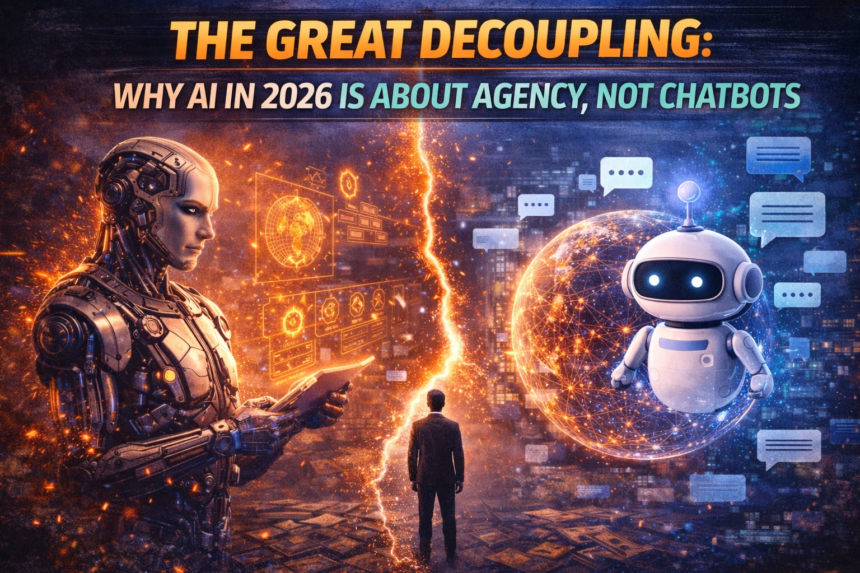
By the close of 2025, the novelty of “talking to a computer” has vanished. In 2026, we are witnessing The Great Decoupling, where Artificial Intelligence is finally moving away from the “chat box” and into the “action layer” of the global economy.
- Introduction
- Context and Background
- 3. What Most Articles Get Wrong
- Deep Analysis and Insight
- Practical Implications and Real-World Scenarios
- Scenario 1: The “Three-Person” Global Brand
- Scenario 2: The Agentic Security Operations Center (SOC)
- Who Benefits and Who Is at Risk?
- 6. Limitations, Risks, or Counterpoints
- Forward-Looking Perspective
- Key Takeaways
- Editorial Conclusion
The era of generative experiments is being replaced by the era of Agentic Autonomy, where systems no longer just suggest content but execute end-to-end business outcomes.
Most discussions overlook the critical transition from task-based productivity to role-based orchestration. What is rarely addressed is the emergence of “Personal AI Fabric”.
A unified intelligence layer that connects a user’s devices, files, and professional identity into a single, proactive entity.
This matters because organizations still treating AI as a “search replacement” will find themselves structurally incapable of competing with “Agent-First” enterprises.
This article uniquely delivers a first-hand analysis of how 2026 is re-engineering the relationship between human intent and machine execution.
We move beyond the 2024 hype to examine the technical constraints of power, the shift toward Physical AI, and the new “Trust-as-a-Service” economy that governs it all.
Context and Background
To understand 2026, we must recognize that the “Scaling Laws” for Large Language Models (LLMs) have hit a logistical wall: Energy. With token production consuming a growing percentage of global power grids, the industry has shifted its focus from “Bigger Models” to “Smarter Architectures.”
The Convergence of Cloud, Edge, and Physical AI
In 2026, the boundary between “the cloud” and “the device” has blurred. Hybrid computing is now the standard, where high-level reasoning happens on massive server farms while real-time, privacy-sensitive “inference” happens locally on specialized AI silicon within your smartphone or laptop.
Defining Agentic Orchestration
We are no longer using “tools”; we are managing “agents.” An agent is a semi-autonomous system that understands a high-level goal (e.g., “Plan and book a 3-day marketing summit in Tokyo”) and independently executes the sub-tasks: negotiating with venues, coordinating attendee calendars, and managing budget approvals.
The Analogy of the Autonomous Vehicle Think of 2024 AI like a high-end GPS: it tells you where to turn, but you still have to drive the car. 2026 AI is the Level 4 Autonomous Drive.
You tell the car the destination, and it handles the steering, braking, and traffic navigation.
You are the passenger who provides the “Why” and the “Where,” but the “How” is handled by the machine.
3. What Most Articles Get Wrong
Mainstream media continues to focus on “Sentience” and “Job Replacement,” missing the actual structural shifts happening in the 2026 labor market.
- Misconception 1: “AI is an Efficiency Play” Most articles frame AI as a way to do existing work faster. In 2026, leading firms realize AI is an Endurance Play.
- It allows companies to maintain 24/7 “Operational Readiness” without human burnout. It’s not about doing more in an hour; it’s about the work never stopping.
- Misconception 2: “Generic Models are the Future” The “God Model” (one AI for everything) has proven too expensive and hallucination-prone for enterprise use. 2026 is the year of Domain-Specific SLMs (Small Language Models).
- A bank doesn’t want an AI that can write poetry; it wants an AI trained exclusively on its own secure ledger history and regulatory codes.
- Misconception 3: “Privacy is Dead” The narrative suggests that AI requires us to give up all data. However, the rise of Federated Learning and On-Device Guardrails in 2026 has actually enhanced data sovereignty. Companies are now training models on encrypted data “islands” where the model learns the patterns without ever seeing the raw sensitive information.
Deep Analysis and Insight
The most significant shift in 2026 is the move from Inquiry to Action, driven by three foundational pillars: Agentic Middleware, Physical AI, and Token Optimization.
Agentic AI as the New Middleware
Claim: AI is becoming the “operating system” of the enterprise. Explanation: In 2026, companies are adopting the Model Context Protocol (MCP). This allows different AI agents (from Microsoft, Google, or open-source providers) to “talk” to each other and interact with internal systems like CRM or HR platforms.
Consequence: This creates a “Digital Workforce.” You don’t “open an app” anymore; you assign a task to your agent, which then navigates the necessary apps on your behalf. The “User Interface” (UI) is increasingly becoming invisible.
The Rise of Physical AI
Claim: AI has finally escaped the screen and entered the “Sensing” world. Explanation: 2026 marks the production-scale rollout of Physical AI. Intelligence embedded in machines that can Sense, Reason, Act, and Learn (SRAL).
This is powered by “World Models” that understand the physics of the real world. Consequence: Warehouse robots, autonomous delivery drones, and smart manufacturing systems are no longer following pre-set paths.
They are making real-time decisions based on physical obstacles, leading to a massive spike in industrial productivity.
Token Optimization and Energy Constraints
Claim: “Cost-per-Token” has replaced “GPU Count” as the primary business metric. Explanation: Because energy is the single biggest roadblock to AI growth in 2026, enterprises are putting Token Optimization at the center of their strategy.
This involves using “Inference-Time Scaling” giving the model more “time to think” on complex problems while using ultra-cheap, “distilled” models for routine tasks.
Consequence: We are seeing the “Agent-as-a-Service” (AaaS) model, where you don’t pay for a software subscription, but for the successful completion of a goal.
Practical Implications and Real-World Scenarios
Scenario 1: The “Three-Person” Global Brand
In 2026, a small team of three people can launch a global product campaign in 48 hours.
- The Process: They direct an “Orchestration Agent” that manages specialized agents for market research, localized content generation, and ad-spend optimization across 20 languages.
- Impact: The “Human-in-the-Loop” focus shifts entirely to strategy and emotional resonance, while the execution layer is fully automated.
Scenario 2: The Agentic Security Operations Center (SOC)
Cyberattacks in 2026 happen in milliseconds, too fast for human intervention.
- The Process: AI security agents detect anomalies, contain threats, and initiate remediation workflows automatically.
- Impact: Security analysts have transitioned into “Agent Pilots,” overseeing a fleet of defensive AI agents and only stepping in to handle high-level policy decisions or ethical dilemmas.
Who Benefits and Who Is at Risk?
- Beneficiaries: Agile Mid-Market Firms that can adopt these agents faster than rigid, legacy-bound conglomerates.
- At Risk: Traditional SaaS Providers who fail to move from “Seat-Based Pricing” to “Outcome-Based Value.” If your software requires a human to click a button, it is obsolete in 2026.
6. Limitations, Risks, or Counterpoints
A critical limitation in 2026 is the “Double Agent” Risk. As agents gain the ability to execute financial transactions and access sensitive systems, the potential for them to be “jailbroken” or manipulated into acting against their owner’s interests is the primary security concern.
Furthermore, Context Collapse remains a hurdle. While models have much larger “context windows” in 2026, they can still lose the thread of a multi-week project. Human “Knowledge Managers” are still required to ensure the AI’s “memory” remains accurate and aligned with the shifting goals of the organization.
Forward-Looking Perspective
By 2028–2030, we expect the convergence of AI and Quantum Computing to solve the energy crisis currently capping AI growth. “Quantum-Augmented AI” will allow for simulations in materials science and drug discovery that are currently impossible even for the most powerful 2026 clusters.
On the social front, we will see the “Human Premium.” As AI-generated content and services become the baseline, anything that is demonstrably human-made from artisanal goods to handcrafted journalism will carry a significantly higher market value. The most successful professionals in 2030 will be those who have mastered “Digital-Human Symbiosis.”
Key Takeaways
- Shift from Chat to Action: Stop building chatbots; start building agentic workflows that can interact with your core business APIs.
- Audit Your Data Foundation: Agentic AI is only as good as the data it can “see.” Modernize your data architecture to be Machine-Readable and Entity-Based.
- Implement Autonomous Governance: As you give AI more “Agency,” you must implement Autonomous Compliance Modules that provide real-time audit trails of every decision.
- Prioritize AI Fluency: Shift employee training from “how to prompt” to “how to direct and oversee” an autonomous digital workforce.
Editorial Conclusion
In 2026, the real frontier of Artificial Intelligence isn’t technological; it’s Organizational. We have reached a point where the machines can do the work; the question is whether our institutions are ready to let them.
At Neuroxa, we believe that the most successful leaders of this era will be the ones who can move past the fear of “control loss” and embrace the power of “delegated intelligence.”
The “AI Plateau” was merely the pause before the leap. Now that we have moved from the screen to the agent, the true potential of the information age is finally being realized.
The goal is no longer to simulate human thought, but to amplify human capability across every physical and digital domain.