



Introduction
Artificial intelligence is often associated with massive data centers, cloud platforms, and centralized computing power. In popular imagination, AI lives far away, processing enormous volumes of data in remote servers owned by large technology companies.
- Introduction
- What Edge AI Really Means in Practice
- Why Edge AI Is Gaining Momentum Now
- The Human Benefits of Local Intelligence
- Edge AI in Everyday Life
- Edge AI in Industry and Infrastructure
- Privacy and Trust in an Edge AI World
- The Limitations and Tradeoffs of Edge AI
- Edge AI and the Future of Work
- Energy Efficiency and Sustainability
- Ethical Considerations at the Edge
- The Role of Policy and Standards
- Education and Awareness
- A More Decentralized Intelligence Landscape
- Human Centered Design in Edge AI
- Conclusion
While this model still dominates many applications, a quieter shift is underway. Intelligence is moving closer to where data is created, decisions are needed, and actions take place. This shift is known as edge AI.
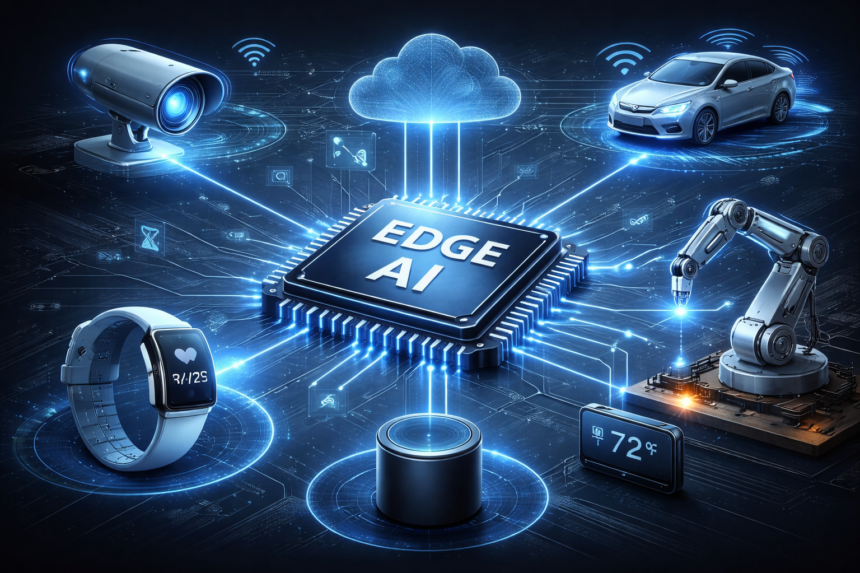
Edge AI refers to artificial intelligence systems that run directly on local devices rather than relying entirely on cloud based processing. These devices can include smartphones, cameras, sensors, industrial machines, vehicles, medical equipment, and everyday consumer electronics.
Instead of sending raw data to distant servers, edge AI processes information locally, often in real time.
This change may appear technical, but its implications are deeply human. Edge AI affects privacy, speed, reliability, trust, and how people interact with technology in daily life.
It changes who controls data, how systems respond to users, and where intelligence truly resides. Understanding edge AI is not only about computing architecture. It is about how society chooses to distribute intelligence across the digital world.
What Edge AI Really Means in Practice
At its core, edge AI combines two ideas. The first is artificial intelligence, which enables systems to recognize patterns, make predictions, and support decision making. The second is edge computing, which places processing power close to the source of data rather than in centralized locations.
In practice, edge AI allows devices to analyze data on the spot. A security camera can detect unusual activity without streaming footage to the cloud.
A wearable device can monitor health signals without constantly uploading sensitive information. A factory sensor can identify equipment failure before it happens without waiting for remote analysis.
This local processing reduces the need for constant connectivity and changes how systems behave under real world conditions.
Edge AI systems can function even when networks are slow, unreliable, or unavailable. This makes them particularly valuable in environments where speed and autonomy matter.
Why Edge AI Is Gaining Momentum Now
Several forces are driving the rise of edge AI. One major factor is the explosion of connected devices. As more sensors and smart products generate data, sending everything to the cloud becomes costly and inefficient. Network bandwidth, energy use, and latency all become constraints.
Another factor is the growing demand for real time responses. Applications such as autonomous vehicles, industrial automation, and medical monitoring cannot afford delays caused by data transmission. Decisions must happen instantly, often within milliseconds.
Privacy concerns also play a significant role. Regulations and public awareness are pushing organizations to limit how personal data is collected, stored, and shared.
Processing data locally allows sensitive information to remain on the device, reducing exposure and risk.
Finally, advances in hardware have made edge AI feasible. Modern chips are powerful enough to run sophisticated models while consuming minimal energy. This makes intelligence at the edge both practical and scalable.
The Human Benefits of Local Intelligence
Edge AI delivers several benefits that directly affect people rather than systems.
Speed is one of the most noticeable advantages. When decisions happen locally, responses feel immediate. Voice assistants react faster. Safety systems respond instantly. User experiences feel smoother and more natural.
Privacy is another key benefit. When data does not leave the device, individuals gain greater control over their information. Health data, location data, and personal behavior patterns can be processed without being transmitted elsewhere.
This reduces the feeling of constant surveillance and builds trust.
Reliability also improves. Edge AI systems do not depend entirely on network connectivity. This matters in rural areas, during outages, or in critical situations where connectivity cannot be guaranteed.
Together, these benefits make technology feel more supportive and less intrusive. Intelligence becomes something that serves people quietly rather than watching them from afar.
Edge AI in Everyday Life
Many people already interact with edge AI without realizing it. Smartphones use on device intelligence for facial recognition, photo enhancement, and voice commands. These tasks happen locally to improve speed and protect privacy.
Smart home devices increasingly rely on edge AI to detect sounds, recognize faces, or adjust environments without sending constant streams of data to the cloud. This makes homes feel more responsive and secure.
In vehicles, edge AI supports driver assistance systems that detect obstacles, monitor attention, and make split second decisions. These functions cannot rely solely on remote servers due to safety requirements.
In healthcare, wearable devices analyze heart rate, movement, and sleep patterns locally, providing immediate feedback while minimizing data sharing.
These examples show how edge AI integrates into daily routines in subtle but meaningful ways.
Edge AI in Industry and Infrastructure
Beyond consumer use, edge AI is transforming industries that depend on precision and reliability.
In manufacturing, machines equipped with edge AI monitor performance, detect defects, and predict maintenance needs. This reduces downtime and improves safety. Workers receive alerts before problems escalate, allowing human judgment to guide interventions.
In energy systems, edge AI optimizes grid performance by balancing supply and demand locally. This supports renewable energy integration and improves resilience.
In agriculture, sensors and drones use edge AI to monitor crops, soil, and weather conditions. Farmers receive actionable insights without relying on constant connectivity, improving efficiency and sustainability.
These applications demonstrate how edge AI supports human decision making rather than replacing it.
Privacy and Trust in an Edge AI World
One of the strongest arguments for edge AI is its impact on privacy. Centralized systems collect vast amounts of data, often beyond what users fully understand. This can erode trust and create fear of misuse.
Edge AI shifts this dynamic. When data stays local, individuals and organizations maintain greater control. Sensitive information does not need to travel across networks or be stored indefinitely.
However, privacy is not automatic. Devices must be designed responsibly, with clear boundaries and transparent behavior. Users need to know what data is processed, how it is used, and when it is deleted.
Trust in edge AI depends on openness and accountability. When people understand that intelligence operates locally for their benefit, acceptance grows.
The Limitations and Tradeoffs of Edge AI
Despite its advantages, edge AI is not a universal solution. Local devices have limited computing power compared to cloud servers. This restricts model size and complexity.
Updating models across millions of devices can be challenging. Security risks also exist if devices are compromised physically or digitally.
Edge AI often works best in combination with cloud systems. The cloud can handle large scale training, long term storage, and coordination, while edge devices handle real time inference.
Understanding these tradeoffs helps set realistic expectations. Edge AI complements centralized intelligence rather than replacing it entirely.
Edge AI and the Future of Work
Edge AI influences how work is organized and experienced. By placing intelligence closer to operations, workers gain faster feedback and greater autonomy.
In logistics, edge AI helps workers route deliveries, monitor conditions, and respond to changes in real time. In healthcare, clinicians receive immediate insights at the bedside rather than waiting for remote analysis.
This shift can reduce cognitive load and improve decision quality. However, it also requires training and trust. Workers must understand how systems support them and where human judgment remains essential.
When implemented thoughtfully, edge AI enhances human capability rather than diminishing it.
Energy Efficiency and Sustainability
Centralized computing consumes significant energy. Data centers require cooling, power, and infrastructure that contribute to environmental impact.
Edge AI can reduce energy use by minimizing data transmission and processing only what is necessary. Local inference often consumes less energy than sending data back and forth to the cloud.
This efficiency supports sustainability goals, especially as the number of connected devices continues to grow. Designing energy efficient edge systems becomes part of responsible AI development.
Ethical Considerations at the Edge
Edge AI raises ethical questions that differ from those of centralized systems. Decisions made locally may be harder to audit or oversee. Bias in models can manifest in many distributed locations.
Ensuring fairness, accountability, and transparency requires careful design. Systems should include mechanisms for logging, explanation, and human oversight.
Ethical edge AI respects user autonomy and avoids hidden manipulation. It supports informed consent and provides meaningful choices.
The Role of Policy and Standards
As edge AI becomes more widespread, standards and policies play a crucial role. Interoperability, security, and safety guidelines help ensure consistent behavior across devices and industries.
Regulation must balance innovation with protection. Overly restrictive rules can slow progress, while lack of oversight can harm trust.
Clear frameworks encourage responsible adoption and help organizations align technology with societal values.
Education and Awareness
For edge AI to deliver its full benefits, people need to understand it. Education should go beyond technical training to include digital literacy and ethical awareness.
Users who understand how local intelligence works are better equipped to make informed choices and advocate for responsible design.
Awareness reduces fear and empowers participation in shaping how technology evolves.
A More Decentralized Intelligence Landscape
Edge AI represents a shift toward decentralized intelligence. Instead of concentrating power and decision making in a few locations, intelligence spreads across many devices and contexts.
This decentralization can support resilience, diversity, and adaptability. Systems become less vulnerable to single points of failure and more responsive to local needs.
However, coordination remains essential. Decentralized intelligence works best when connected through shared principles and standards.
Human Centered Design in Edge AI
Design choices determine whether edge AI feels supportive or intrusive. Human centered design prioritizes clarity, respect, and usefulness.
Interfaces should explain actions clearly. Systems should allow users to override or adjust behavior. Feedback should be understandable rather than opaque.
When edge AI is designed around human needs, it becomes a trusted companion rather than a hidden authority.
Conclusion
Edge AI marks an important evolution in how artificial intelligence fits into human life. By moving intelligence closer to where data is created and decisions are made, it changes the balance between speed, privacy, and control.
This shift affects more than technology. It influences trust, autonomy, work, and daily experience. Edge AI has the potential to make systems more responsive, respectful, and resilient, but only if designed with human values in mind.
The future of AI is not only about making machines smarter. It is about deciding where intelligence belongs and how it serves people. Edge AI offers a path toward technology that works quietly, locally, and in closer alignment with human needs.