

A strategic guide for creative directors, independent producers, and media technologists
1. Introduction
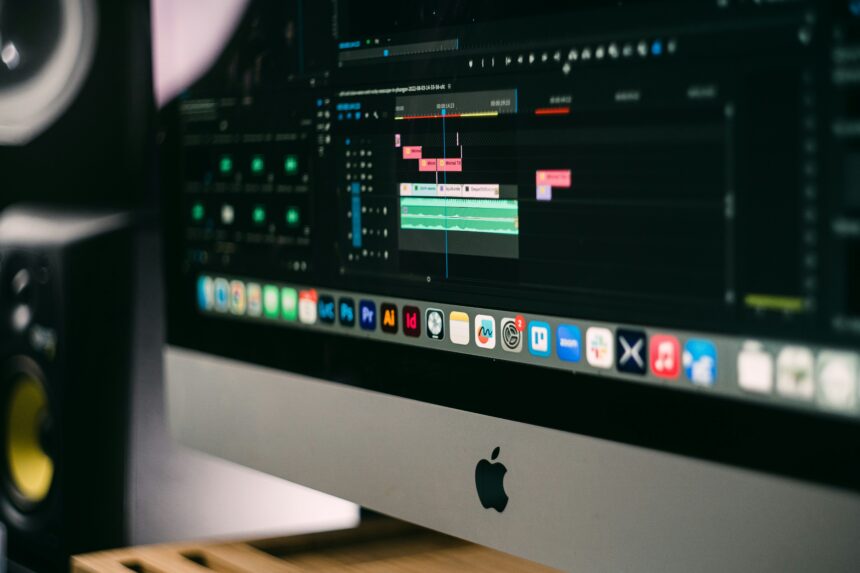
For nearly thirty years, the “timeline” has been the universal language of content creation. Whether in Premiere Pro or Logic Pro, creators have painstakingly layered tracks of audio and video, frame by frame. But as we enter 2026, this linear architecture is being dismantled. The future of content creation is no longer about manipulating media, but about directing intent.
- 1. Introduction
- 2. Context and Background
- 3. What Most Articles Get Wrong
- 4. Deep Analysis and Insight
- Semantic Editing: Cutting by Concept, Not Time
- Spatial Audio and Neural Sound Design
- The Rise of “Agentic Orchestration”
- 5. Practical Implications and Real-World Scenarios
- Scenario A: The Solo “Media House”
- Scenario B: Corporate “Just-In-Time” Training
- Who Benefits and Who Is at Risk?
- 6. Limitations, Risks, or Counterpoints
- 7. Forward-Looking Perspective
- 8. Key Takeaways
- 9. Editorial Conclusion
Most discussions overlook the shift from “Generative AI” (making a single clip) to “Agentic Orchestration” (AI systems that manage entire production pipelines). What is rarely addressed is the emerging “Creative Singularity,” where the barriers between text, audio, and video dissolve into a single, multimodal workspace. This matters because the competitive advantage is shifting from technical mastery of software to the clarity of creative vision.
This article uniquely delivers an editorial analysis of the technologies that will define the 2026–2027 landscape. We will explore how “circular workflows” are replacing linear ones and why the most valuable skill for the next decade isn’t editing. It’s curation and prompt-based architecture.
2. Context and Background
To understand where we are going, we must define the current technological baseline. We are transitioning from Discriminative AI (tools that help us find or tag things) to Generative Multimodality (tools that create across different formats simultaneously).
The Rise of Multimodal LLMs
In 2024, a creator needed one tool for scripts, another for images, and a third for voiceovers. By 2026, models like GPT-5 and Gemini 2.0 operate natively across all these formats. They don’t “translate” text into video; they understand the underlying “world physics” of a scene, ensuring that a character’s voice, movement, and lighting are perfectly synchronized from the first second.
From Plugins to Agents
We are moving beyond “plugins” small bits of code that perform one task to “Creative Agents.” These are autonomous sub-systems that can research a topic, draft a storyboard, and generate a rough cut without human intervention, presenting the creator with three “draft directions” to choose from.
The Analogy of the Orchestral Conductor In the past, a content creator was like a solo musician who had to play every instrument themselves, one at a time, to record a song. The future creator is a Conductor. They don’t play the violin; they communicate the tempo, mood, and dynamics to an orchestra of AI agents that execute the technical work in real-time.
3. What Most Articles Get Wrong
Current media coverage of AI tools is often blinded by “feature-chasing,” ignoring the structural shifts in how humans actually work.
- Misconception 1: “AI Will Replace the Camera” Many pundits predict the end of live-action filming. In reality, the future is “Hybrid Reality.” Cameras are becoming Data Collectors. Instead of just capturing pixels, future cameras will capture “Gaussian Splats” (3D volume data), allowing editors to change the camera angle or lighting after the shoot is over.
- Misconception 2: “Prompt Engineering is the Final Skill” The idea that we will all just “type a movie into existence” is a temporary phase. By 2027, “Natural Language Editing” (voice-activated commands) and “Visual Prompting” (drawing a rough sketch to guide the AI) will replace complex text prompts. The future isn’t about learning to talk to computers; it’s about computers learning to understand humans.
- Misconception 3: “Quality is the Only Metric” Most articles focus on how realistic AI video looks. They ignore Personalization at Scale. The real “future” isn’t a better-looking 30-second ad; it’s the ability to generate 10,000 different versions of that ad, each tailored to the specific interests, language, and cultural context of individual viewers.
4. Deep Analysis and Insight
The most profound change in creation tools is the move toward Semantic Editing and Spatial Audio Synthesis.
Semantic Editing: Cutting by Concept, Not Time
Claim: The “Frame” is becoming obsolete as the primary unit of editing. Explanation: In 2026, tools like Descript and Premiere have evolved into Semantic Engines. You no longer “cut” a clip at 04:22; you tell the AI to “find the moment the speaker looks frustrated and replace the background with a rainy street.” Consequence: This removes the “Technical Debt” of editing. It allows creators to iterate at the speed of thought. If you can describe it, the tool can manifest it, shifting the bottleneck from “how to edit” to “what to say.”
Spatial Audio and Neural Sound Design
Claim: Sound design is shifting from “recorded samples” to “generative environments.” Explanation: Future audio tools don’t just layer sound effects; they simulate the acoustic physics of a space. If you generate a video of a cave, the AI automatically generates the reverb, the dripping water, and the footsteps that perfectly match the character’s weight and the cave’s dimensions. Consequence: This creates a “Presence Floor” that was previously only achievable by Hollywood Foley artists. High-fidelity immersive audio will become the standard for even the smallest independent creators.
The Rise of “Agentic Orchestration”
Claim: Production “management” is being automated alongside production “creation.” Explanation: Advanced tools are integrating “Agentic” capabilities. A creator can say, “Produce a 5-minute documentary on the history of salt,” and the AI agent will independently source public domain footage, generate missing B-roll, clone a narrator’s voice, and mix the audio. Consequence: This democratizes high-production-value storytelling. The “Studio” is no longer a building; it is a single seat in front of a multimodal interface.
5. Practical Implications and Real-World Scenarios
Scenario A: The Solo “Media House”
An independent YouTuber in 2026 uses a multimodal suite to turn a single 10-minute interview into a vertical TikTok series, a localized Spanish version with perfect lip-sync, and a 3D immersive VR experience for their Patreon.
- Impact: The creator’s “leverage” increases by 10x without hiring a single employee. They focus entirely on the interview quality while the “Orchestration Agent” handles the multi-platform distribution.
Scenario B: Corporate “Just-In-Time” Training
A global corporation needs to update its safety training for 50 different countries.
- Action: Instead of a six-month film shoot, they use “Digital Twins” of their actual facility. The AI generates localized presenters who speak the local dialect and reference specific local safety codes.
- Impact: Training is deployed in 48 hours instead of 6 months, drastically reducing workplace accidents and “Information Decay.”
Who Benefits and Who Is at Risk?
- Beneficiaries: Creative Directors who can now oversee entire “worlds” rather than just single files.
- At Risk: Technical Specialists (e.g., rotoscope artists or basic color graders) whose roles are being fully subsumed by one-click AI functions.
6. Limitations, Risks, or Counterpoints
The greatest risk of this “frictionless” future is Creative Homogenization. When tools make it easy to generate “perfect” content, everything begins to look the same the “average of the internet.” The “Human Signal” imperfections, weirdness, and radical original thought will become the only way to stand out.
Additionally, the Legal Fog surrounding training data remains a barrier for large-scale enterprises. Until “Clean Models” (trained only on licensed data) become the industry standard, many major studios will be hesitant to use generative tools for their primary IP, fearing copyright lawsuits that could last a decade.
7. Forward-Looking Perspective
By 2028, we anticipate the arrival of Real Time Interactive Media. We will stop “watching” videos and start “entering” them.
The tools used to create movies will merge with the tools used to create video games (like Unreal Engine 6). Viewers will be able to change the POV of a documentary as it plays, or ask a character in a movie a question and receive a real-time, AI-generated response. The “Video File” will be replaced by the “Generative Environment,” a package of assets and AI weights that renders the story differently for every viewer.
8. Key Takeaways
- Invest in Vision, Not Just Tools: Don’t just learn a software interface; learn the principles of storytelling, composition, and rhythm. The “how” is being automated; the “what” is the value.
- Adopt Hybrid Workflows: Use AI for the “heavy lifting” (B-roll generation, rotoscoping, transcription) but keep “Human Gates” for emotional resonance and final polish.
- Master the “Director” Skillset: Practice communicating complex ideas clearly. Your ability to “direct” an AI agent is the new “technical mastery.”
- Stay Provenance Aware: As deepfakes proliferate, use C2PA-enabled tools to prove your content is authentic and protect your brand’s trust.
9. Editorial Conclusion
We are witnessing the “Prosthetic Era” of creativity. AI tools are no longer external objects we use; they are becoming extensions of our own cognitive and creative faculties. At Neuroxa, we believe the fear that “AI will kill art” is a misunderstanding of history. Every major leap in tools from the oil paintbrush to the digital camera was met with the same anxiety.
The future belongs to the “Polymath Creator” the individual who understands enough about sound, light, and narrative to guide the machine toward something truly soul-stirring. The “Plateau” of productivity only exists for those who use AI to do the same old things faster. For those who use it to do things that were previously impossible, the ceiling has completely disappeared.